Subscribe to Newsletter
 Donate
 Shop
Shop 0
0






2026 Kelp Forest Monitoring Trainings Now Open!
Register Today!
Reef Check’s Kelp Forest Monitoring training classes for 2026 are now open for registration! There are five opportunities in California, Oregon and Baja California for divers to get involved as citizen scientists. Oregon will also be hosting two restoration trainings for those wanting to assist with kelp forest restoration. Visit our training page for details and to sign up! If you have been previously trained as a Reef Checker, you can sign up for one of our recertification classes to get ready for the upcoming survey season at http://calendar.reefcheck.org.

Children’s Book
Benefits Reef Check Hawai’i
Reef Check Hawai’i’s first ever children’s book is now available through Barnes and Noble, with every purchase supporting Reef Check Hawai’i!
Polly Polyp and the Curious Baby Shark is a gentle ocean tale set on a sunny Hawaiian reef, where a curious baby shark named Nalu wonders where he belongs. He meets Polly Polyp (a tiny coral polyp with a big heart), and together they discover how every reef creature has an important role to play, including sharks!
Polly and Nalu uncover a simple truth: healthy reefs depend on cooperation and balance. Through friendship and curiosity, fear gives way to understanding, and the reef becomes a place where everyone belongs.
Perfect for young readers, this story celebrates the circle of life and the power of asking questions, showing that even the smallest coral polyp and the youngest shark can make a big difference.
Reef Check Coral Data Featured in Two Recent Publicationsvation
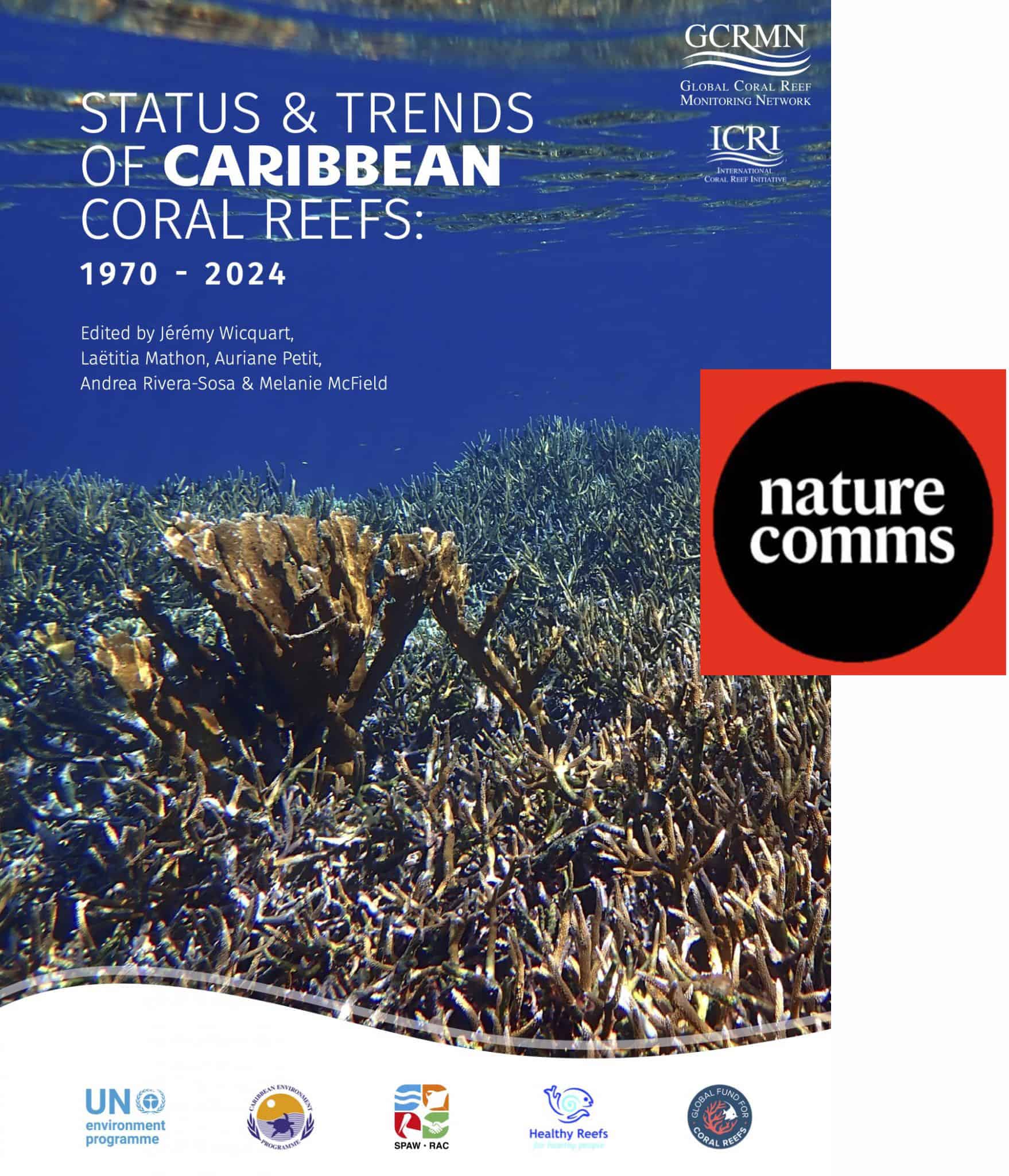
Earlier this month, Nature Communications published the article, “Severe and widespread coral reef damage during the 2014-2017 Global Coral Bleaching Event”. The paper relied on Reef Check’s coral reef data and warns that “the impacts of ocean warming on coral reefs are accelerating, with the near certainty that ongoing warming will cause large-scale, possibly irreversible, degradation of these essential ecosystems”. Another alarming report was published by the Global Coral Reef Monitoring Network (GCRMN) in December. “Status and Trends of Caribbean Coral Reefs: 1970-2024“ is the most comprehensive assessment of Caribbean reefs to date. It draws on over 23,000 surveys—including more than 2,700 Reef Check surveys—and shows that coral cover in the Caribbean has declined by 48% since 1980, while macroalgae cover has risen 85% in the same time. Together, they demonstrate that Reef Check’s global dataset is not only vital for documenting large-scale change, but also indispensable for informing management and policy worldwide.


Video Spotlight: Winter Webinar Series 2026
The first two presentations in our Winter Webinar series for 2026 are in the books:
“Kelp Communities Across Puget Sound Basins” explores data from our first few years of surveys in Washington, highlighting distinct regional kelp forest communities of fish, invertebrate and kelps within sub-basins of Puget Sound.
“California Fish and the Marine Heat Wave” examines how fish assemblages changed after the 2014-16 marine heat wave which had large scale impacts on kelp beds along the California coast.

Reef Check in Panamá Launches with Coordinator and Training Facility
Ankay Conservation, in Bocas del Toro, Panamá—on the Caribbean coast—has always been about turning real, on-the-water work into measurable reef protection. They combine hands-on conservation action with community collaboration and strong field logistics to support reef resilience where it matters most. Becoming an official Reef Check Training Facility was a natural next step for their team and they are now welcoming divers who want to level up their conservation impact by becoming a Reef Check EcoDiver.
The 2025 Reef Check Malaysia Survey Results and What They Mean for Our Coral Reefs
Reef Check Malaysia’s 2025 survey report has been published and data from surveys at over 300 sites around the country last year show a continuing decline in reef health- 10% of live coral cover was lost in one year, the equivalent of 47,250 football fields worth of corals lost. Back in 2022, live coral cover was about 50%, meaning 20% of coral reefs in Malaysia have been lost since 2022. Julian Hyde, CEO of Reef Check Malaysia, shares his thoughts on what this all means.


Join Reef Check Italia for “Methods in Tropical Reef Monitoring” at Bangka Island, Indonesia
From September 12-20, 2026 Reef Check Italia and Coral Eye will host an international field course on coral reef monitoring approaches open to both marine biology students and volunteer divers from around the world. The course, taught in English, focuses on coral identification and disease, coral reef monitoring approaches, and the Reef Check EcoDiver and Coral Watch protocols. Participants will receive a Reef Check EcoDiver certification. Scholarship opportunities are available!
Reef Check in the News
Malaysia lost 20% of its coral reefs in three years – Mongabay
Malaysia lost 47,250 football fields worth of its coral reefs in last three years – The Star (Malaysia)
Sabah coral reefs under threat from rising crown-of-thorns starfish population – New Straits Times (Malaysia)
For more, visit www.reefcheck.org/press/