Subscribe to Newsletter
 Donate
 Shop
Shop 0
0








Earlier this month, Nature Communications published the article, “Severe and widespread coral reef damage during the 2014-2017 Global Coral Bleaching Event”. The paper relied on Reef Check’s coral reef data and warns that “the impacts of ocean warming on coral reefs are accelerating, with the near certainty that ongoing warming will cause large-scale, possibly irreversible, degradation of these essential ecosystems.”
During 2014-2017, marine heatwaves caused the Third Global Coral Bleaching Event. The paper analyzes data from 15,066 reef surveys globally during 2014-2017. Across all surveyed reefs, 80% experienced bleaching of more than 10% of corals on the reef and 35% experienced coral mortality. Based on these survey data, models predict that about 50% of the world’s coral reefs suffered from bleaching and 15% had coral mortality during one or multiple years. This finding marks this as the most severe bleaching event, surpassing damage from any prior global coral bleaching event and suggests that impacts of ocean warming are accelerating.
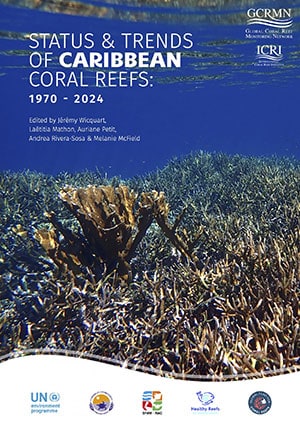
Another alarming report was published by the Global Coral Reef Monitoring Network (GCRMN) in December. The “Status and Trends of Caribbean Coral Reefs: 1970-2024” report is the latest scientific assessment of the region’s coral reef health, revealing both declines driven by climate change and local environmental pressures, but also detecting encouraging signs of recovery where effective management and protection measures are in place. The report shows that coral cover in the Caribbean has declined by 48% since 1980, while macroalgae cover has risen 85% in the same time. This report was compiled by more than 300 scientists across 44 countries and territories; it draws on over 23,000 surveys—including more than 2,700 Reef Check surveys—from nearly 14,000 sites collected between 1970 and 2024.
These two major scientific assessments underscore both the accelerating crisis facing coral reefs and the critical importance of long-term, global monitoring efforts like Reef Check’s surveys. Together, they demonstrate that Reef Check’s global dataset is not only vital for documenting large-scale change, but also indispensable for informing management and policy worldwide. Importantly, the Caribbean assessment also identified areas where strong local protection and management have supported coral recovery—offering clear evidence that when action is taken, reefs can rebound and hope remains for their future.