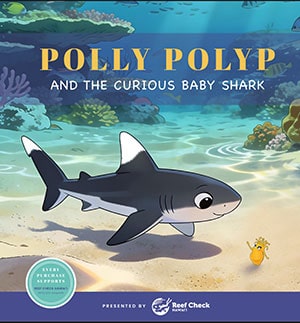
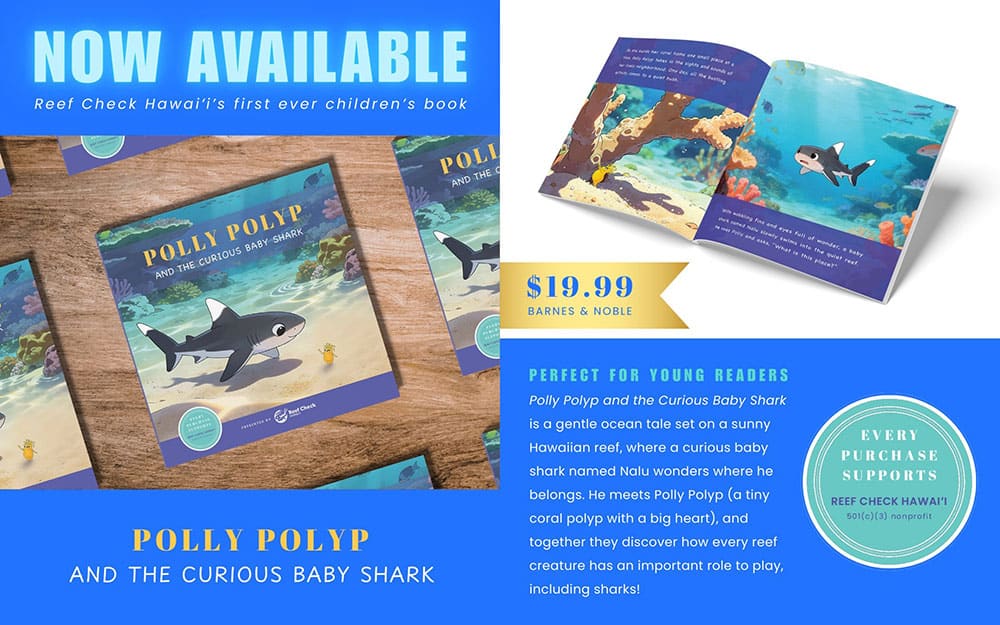
Reef Check Hawai’i’s first ever children’s book is now available through Barnes and Noble, with every purchase supporting Reef Check Hawai’i!

Polly Polyp and the Curious Baby Shark is a gentle ocean tale set on a sunny Hawaiian reef, where a curious baby shark named Nalu wonders where he belongs. He meets Polly Polyp (a tiny coral polyp with a big heart), and together they discover how every reef creature has an important role to play, including sharks!

Polly and Nalu uncover a simple truth: healthy reefs depend on cooperation and balance. Through friendship and curiosity, fear gives way to understanding, and the reef becomes a place where everyone belongs. Perfect for young readers, this story celebrates the circle of life and the power of asking questions, showing that even the smallest coral polyp and the youngest shark can make a big difference. The book is available through Barnes and Noble.
By Paula Sills, Reef Check Coordinator for Panamá

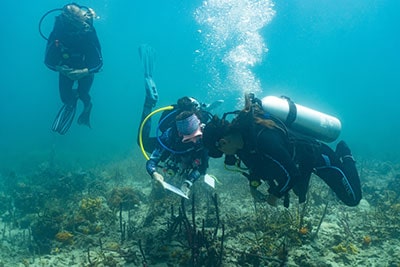
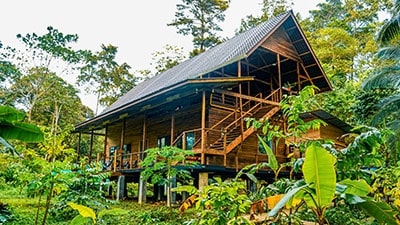
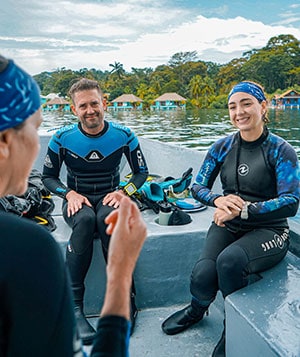
Ankay Conservation, based in Bocas del Toro, Panamá—on the Caribbean coast—has always been about turning real, on-the-water work into measurable reef protection. We combine hands-on conservation action with community collaboration and strong field logistics to support reef resilience where it matters most. Becoming an official Reef Check Training Facility is a natural next step for our team: it aligns perfectly with our mission to expand credible reef monitoring and grow the network of people collecting data that can truly support local management and long-term conservation.

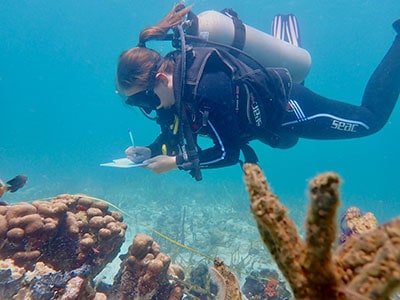
Reef Check fits into our work because it’s practical, standardized, and globally recognized—exactly what’s needed when you’re trying to compare reef health over time and across regions. From coral and substrate categories to indicator fish and invertebrates, the methodology brings structure and consistency, which is essential for tracking change and understanding what’s driving it. As a training center in Bocas del Toro, we’re excited to contribute to Reef Check’s wider impact by helping EcoDivers gain the skills and confidence to survey reefs responsibly, accurately, and safely in Caribbean reef environments.

Our EcoDiver training experience has been a reminder that good monitoring is as much about discipline as it is about passion. Learning to slow down, stay consistent, and prioritize data quality—while managing buoyancy, team communication, and environmental awareness—completely changes the way you dive. The training deepens your ability to “read” a reef, not just admire it, and it builds a shared language among divers that makes every survey stronger and more reliable.

For anyone interested in getting trained with us, we welcome divers who want to level up their conservation impact—whether you’re a local professional, a visiting researcher, or a committed recreational diver ready to contribute. Trainings focus on field-ready skills, survey standards, and real practice in the water, with an emphasis on safety, accuracy, and leaving the reef undisturbed. If you’ve been looking for a way to transform your time underwater into meaningful conservation work, we’d love to connect—come train, learn the method, and become part of a global community protecting reefs through data.

Contact Paula Sills for more information.

By Julian Hyde, Chief Executive Officer of Reef Check Malaysia

I’m not sure I know how to do this anymore, to make it effective and impactful. It feels like every year I talk about the results of the annual surveys…but nothing seems to change.

But here we go…

Overview of the 2025 Reef Check Survey Results

Our 2025 survey report has been published. The data from surveys at over 300 sites around Malaysia last year show a continuing decline in reef health.

Live coral cover (the national average) reduced from about 45% in 2024 to 40% in 2025. That’s a loss of 5 percentage points, or 10% of coral cover in one year.

Back in 2022, live coral cover was about 50%. Looked at one way, you could say we lost 10 percentage points, or 20% of coral reefs since 2022.

20%

Imagine if someone told you that one fifth of Malaysia’s forests were cut down in a few years. Or, to use a different measure, that’s about 47,250 football fields gone. Would that mean anything to you, would it have any effect on you? Or is it just too big a number for people to comprehend?

Nonetheless, that’s what the data are telling us. We lost 47,250 football fields worth of corals last year.

Why Are We Losing Our Coral Reefs?

Malaysia was hit by the mass coral bleaching phenomenon in 2024

Bleaching is a big part of it.

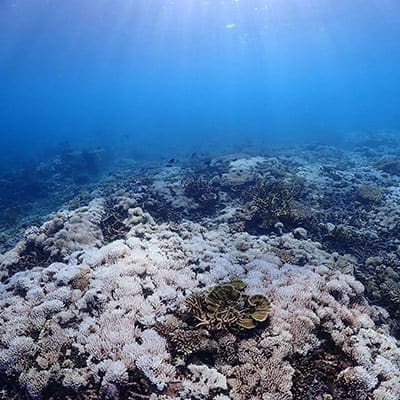
2024 is now acknowledged by marine scientists as the 4th global bleaching event. In Malaysia, over 90% of corals bleached during the peak of the bleaching season in April to June 2024. The 2025 data reveal just how much coral survived…and how much died.

Add to that growing impacts from tourism. In September last year, Johor closed six islands to tourism. Redang is seeing an increase in day trips from the mainland. Seri Buat similar. And Semporna has seen a huge increase in tourism numbers over the last few years.

And pollution from inadequate sewage treatment. And over-fishing. And …so on. Many impacts…though most of these problems can be fixed relatively easily.

Why Is the Loss of Coral Reefs a Problem?

I’m sure most people are already aware…but let’s do this one more time.

We lost 47,250 football fields worth of corals last year.

Coral reefs support food security for coastal communities, as they are part of the nursery system (along with mangroves and seagrass) that produces the fish targeted by those small-scale fishers.

According to one source there are over 140,000 small-scale fishers in Malaysia. That’s basically 140,000 households that rely on coastal fisheries for food and incomes. Which in turn rely on those ecosystems being healthy.

Coral reefs are also an important tourism product. According to some sources, tourism accounts for 15% of GDP and 25% of employment in Malaysia. No coral reefs… diminished tourism?

Don’t get me wrong. We are not anti-tourism; but we are pro-sustainable tourism.

Why Should I Care About Coral Reefs?

This is not a nature conservation issue. This is a food security and jobs issue.

This affects every one of us.

  • FAO statistics show that Malaysians are one of the largest per capita consumers of seafood – around 57 kg per person per year. Imagine that gone because we didn’t look after the ecosystems?
  • Say coral reef decline continues. Some sources suggest that might have an impact on tourism, leading to a reduction in numbers. So, all those people working in tourism on the islands, and the East Coast…they are going to migrate to where there are other jobs, putting pressure on housing, medical care, schools…you do the math.

Focus on the Resilience of Our Reefs

We can support our reefs by removing local impacts

There’s not much we can do about bleaching…actually, quite honestly there’s nothing we can do about bleaching at a local level.

That’s why I keep banging on about resilience – basically eliminating or reducing all the local impacts so reefs are as healthy as possible to withstand the big external impact – whether you call it ocean warming, climate change, global warming…the outcome is the same: diminished marine ecosystems.

We have solid data showing a decline in coral reefs. We know the implications of this for food security and jobs. We need action now to address these challenges. Resilience provides a science-based approach.

What Can You Do to Support Our Reefs?

We get asked this a lot. Usually, we talk about minimizing your own consumption, being a good citizen…recycling, that sort of thing.

I don’t think that’s enough anymore.

We need more people to support efforts to lobby the government, MPs, ADUNs, EXCOs – basically the decision makers who can actually change things.

We met some recently and I was pleasantly surprised by the positive reaction we received. We need their support to make the changes we need if we are to conserve these critical ecosystems.

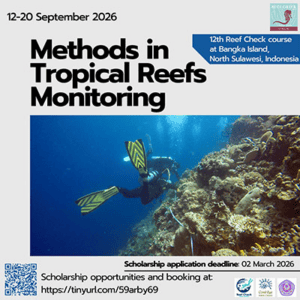
From September 12-20, 2026 Reef Check Italia and Coral Eye will host an international field course on coral reef monitoring approaches open to both marine biology students and volunteer divers from around the world. The course, taught in English, aims to:

  • Provide the basic knowledge for the identification of hard corals and their diseases
  • Present an overview of the well-established coral reef monitoring approaches
  • Learn and apply different methods underwater, including Reef Check and Coral Watch protocols
  • Contribute to the monitoring and conservation of the coral reefs at the Bangka outpost

Lectures and seminars will be alternated with day and night dives, as well as practical sessions. At the end of the course, it is expected that the participants demonstrate what they learned and discuss the results achieved. Participants will obtain the EcoDiver certification issued by the Reef Check Foundation.

Participation in the course is open to anyone who is passionate about coral reefs and has a minimum of diving experience and marine life knowledge. Participation of university students and young marine biologists is encouraged and supported through scholarships.

For more information about this course and how to sign up, please visit:
https://www.reefcheckmed.org/italiano/reef-check-tropical/bangka-2026

Top Row:
Southern California had the honor of completing the 2,000th kelp forest monitoring survey at Cathedral Cove off Anacapa Island

Participants from the Los Angeles and Antelope Valley Dive into Science program on Catalina Island during their Open Water scuba certification

The newest cohort of Reef Check kelp forest divers after finishing their Northern California training in Fort Bragg

Bottom Row:
After powering through cold water and low visibility with positivity and enthusiasm, these trainees joined the Reef Check Washington family this season

Reef Check EcoDivers from across the US gathered in Barbados for a collaborative mission between CARES and Barbados Blue to save the local coral reefs (Photo: Kramer Wimberley, DWP-CARES)

Reef Check Trained Restoration Divers “Kelp Forest Defenders” removing urchins from Nellie’s Cove, Oregon

As the year comes to a close, I want to extend my sincere gratitude for your support. Thanks to our global network of volunteers, donors, and partners, 2025 has been a milestone year for Reef Check.

We celebrated the 20th anniversary of our Kelp Forest Monitoring Program, completed our 2,000th kelp survey, and launched a new monitoring program in Chile. We also strengthened our team by hiring a Dive into Science Program Coordinator and new Volunteer Coordinators in Oregon and Washington, expanding our reach along the West Coast.

Across our coral reef programs, we welcomed Aqualink as an official Global Reef Tracker partner, contributed data to the GCRMN Pacific assessment of coral reefs, and held our first tropical EcoDiver/Kelp Forest crossover course in Hawai‘i. 

Our education and community programs grew as well, with 53 new scuba certifications, expansion of Dive into Science into Oregon with ORKA and the Coquille Indian Tribe, and the completion of a Kelp Forest Monitoring course with the Coastal Chumash and Tongva Community program.

In restoration, we launched Oregon’s first Kelp Defenders training program and completed 33 surveys across ten restoration sites—important steps toward rebuilding resilient kelp forests.

If you are able, I respectfully ask you to consider making a year-end donation to help sustain and expand this vital work. To help amplify your impact, all donations—whether made as a one-time gift or as a new monthly contribution—will be matched dollar for dollar up to $7,500

Thank you for being part of the Reef Check community. I wish you and your loved ones a joyful holiday season and look forward to what we will accomplish together in the year ahead.

With heartfelt gratitude,

Jan Freiwald
Executive Director
Reef Check Foundation

2025 Successes

Organizational

  • Hired Dive into Science Program Coordinator
  • Hired Volunteer Coordinators for Oregon and Washington

Kelp Forest Program

Coral Reef Program

Education Program

  • Achieved a total of 53 scuba certifications across all programs
  • Successfully completed a Reef Check Kelp Forest Monitoring certification course as part of the Coastal Chumash and Tongva Community program
  • Expanded Dive into Science program into Oregon in partnership with ORKA (Oregon Kelp Alliance) and Coquille Indian Tribe

Restoration Program

  • Launched our first restoration training program in Oregon; the “Kelp Defenders” were trained to monitor restoration sites and remove urchins from restoration sites
  • Monitored 10 restoration sites and completed a total of 33 restoration surveys 

By Dan Abbott, Director of Kelp Forest Program

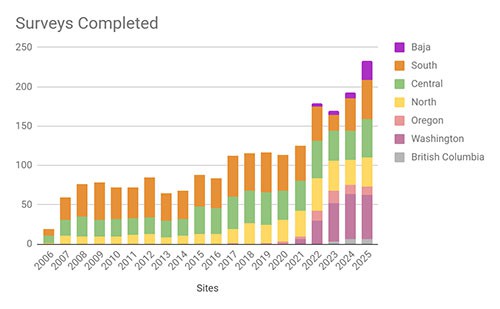
On December 10th, Reef Check finished their 2025 kelp forest survey season. This was our 20th season surveying kelp forest, and for the first time, we completed over 200 surveys in a season, including our 2,000th survey! This was a monumental effort and we could not have done it without our 250+ amazing volunteer divers who completed roughly 3,000 dives to collect this vital data. They braved cold water, long swims, rough boat rides, difficult shore entries, poor visibility, and heavy surge and current, to measure the health of these amazing ecosystems. Thank you all for your passion and dedication!

This truly was a team effort! In addition to our amazing volunteers we’d like to thank all of our partners from aquariums, non-profits, universities, tribes, and government agencies, who collected data on our behalf. We want to give a huge shout-out to our supporters in the dive community, including all of the dive shops that generously donated air fills to our volunteers so they could complete this work. We’d like to thank all the boats and captains who got us safely to our sites with a special mention to long-time Reef Check supporter Phil Sammet who captained us for almost 30 days this year and donated his boat and time on several occasions. Lastly, we want to thank the California Department of Fish and Wildlife who gave us time on the RV Garibaldi that enabled us to access almost half our sites in Southern California. We could not have done this without all of you!

Finally, we want to thank all our funders who made this work possible including all of our volunteers who went above and beyond volunteering and donated money so we could survey sites that we otherwise would not have been able to! One volunteer in particular deserves special thanks. Louise & Jim Wholey’s generous donation in 2025 enabled us to survey a large number of sites on the Central Coast of California that we otherwise would not have been able to get to. Thank you Louise & Jim, and thank you all!

This impressive effort makes a significant contribution to the conservation and protection of our kelp forests, which are under stress due to multiple, often poorly understood stressors.  In 2025 Reef Check data was used in dozens of scientific papers, reports, and presentations. This data, that we collected over the past 20 years sheds light on the fate of these ecosystems so scientists, managers, and ocean dependent communities can take actions to protect and conserve the ecosystems. A huge thanks to the massive team that worked together to make our ocean healthier. You rock!

Below are messages from our regional managers addressed to their teams. Enjoy reading their highlights of the season. 

Washington
By Shawn Augustine, Volunteer Coordinator

The 2025 survey season has come to an end, and I want to thank everyone who came out and participated in surveys this year, as well as our partners and the boat captains who got us out to some of our sites. We certified 30 new volunteers and recertified 22 returning volunteers who, along with our partners, surveyed 62 sites, including 6 in British Columbia. Special shout-outs to our Rookie of the Year, Sofie Broznowski, who never failed to bring the positive vibes and our Golden Slate winner with 19 survey dives, Michelle Halpin, who stepped up to attend some of our last-minute dives.

Oregon
By Diana Hollingshead, Regional Manager

Thank you for a fantastic 2025 season. We are already starting to plan 2026. Additional sites, more volunteer opportunities, more restoration opportunities, more camaraderie and fun! ORKA (Oregon Kelp Alliance) has put together a snapshot of how Reef Check divers contributed to their work this year.  Be proud of yourselves! You made an impact. 

Northern California
By Ian Norton, Regional Manager

The 2025 Field Season has come to a close and I want to thank you all for your help and camaraderie. A lot of our sites on the North Coast are quite rural, and many of you commuted several hours or more to lend a hand with our annual surveys. Your dedication to helping us collect this important data is greatly appreciated! 

I’d like to congratulate our Golden Slate winners: Morgan Wren and Lauren Nutt with 9 survey dives each! This year, we had a record number of volunteer dive days on the North Coast with 104, a testament to the tenacity of our divers.

Central California
By True Barnes, Regional Manager

Although we started the season with less resources and funding than in typical years, due the tenacity and generosity of our volunteers, we had one of the most productive years ever! This year, we overcame a lack of typical boat diving by using kayaks, DPVs (Diver Propulsion Vehicles), difficult shore entries and swims, as well as some boat-use donations from our friends, captains, and partners. 

However, it was our volunteer Louise Wholey (and her husband, Jim), whose incredibly generous donation allowed us to survey every Reef Check site in the Central Coast including San Luis Obispo which had not been fully surveyed since 2022. Louise also attended some of our most interesting surveys including some deep boat dives, difficult entry shore dives, and two DPV surveys with her daughter Mary. 

This season we completed 49 sites from shore, kayaks, boats and with DPVs, the most ever done on the Central Coast!  Each year, two big awards are given out, the Golden Slate Award for the highest number of volunteer days goes to  Philine Marchetta with 17 Days! And the Rookie of the Year Award for the highest number of volunteer days attended by a brand new goes to Dachuan Zhang with 20 Days! Both divers showed extreme dedication, attending surveys across all three California regions with no discrimination on sites or entry methods.

A final thank you to our partners and boat captains whose contributions in time and resources made this season the success that it was! Special thank you to Rick Rowett, Mike Albers, and of course Phil Sammet, who personally captained us out 27 days this season in Monterey, Half Moon Bay, and Morro Bay!

Southern California
By Jaclyn Mann, Regional Manager

As 2025 comes to a close, I want to take a moment to congratulate you all on another stellar survey season! This year we were able to complete 50 surveys in Southern California, which is quite the feat and is only possible because of your continued commitment to Reef Check’s monitoring program. Thank you for the hours upon hours of hard work you put in this year, the early mornings, and the long drives throughout the region that made all of this possible. You’re all rockstars and I’m looking forward to seeing what we can accomplish together next season!

Super special shoutouts to our Golden Slate winners, Jonah Rubash and Svetlana Isaeva, who rarely missed an opportunity to dive with a total of 28 survey days each. Earning an honorable mention is Roland Azurin with 27 survey days. These three divers are absolute workhorses and great mentors to our less experienced surveyors. Congratulations also goes out to our Rookie of the Year, Saam Shams, with 15 survey days. Saam was fully committed to improving his survey skills this year by diving as much as he could and his hard work totally paid off!

2025* Reef Check Data in Action

*using 2024 or earlier data

Scientific reports and papers

  • Drivers of spatiotemporal variability in a marine foundation species. Ecological Applications, February 2025. Anita Giraldo-Ospina, Tom Bell, Mark H. Carr, Jennifer E. Caselle
  • Kelp in the Salish Sea: Spatial Patterns of Persistence, Loss, and Data Gaps Using a Harmonized Dataset. WWU Graduate School Collection, Spring 2025. Lamai S. Larsen
  • How establishing a marine protected area network has shaped community and citizen science along California’s coast. Frontiers in Marine Science, May 2025. Todd A. Harwell, Ryan M. Meyer and Heidi L. Ballard
  • Multiscale analysis of zooarchaeological data to reconstruct past kelp forest productivity for the Northern Channel Islands, California U.S.A.. Estuarine, Coastal and Shelf Science, May 2025. Jeremy D. McFarland, Amira F. Ainis, Christopher S. Jazwa
  • Reef Check Washington Report: The State of Kelp Forests in Puget Sound 2023-25. Reef Check Foundation, June 2025. Jan Freiwald, Jackie Selbitschka, Dan Abbott
  • Reef Check Kelp Forest Monitoring California Report 2024. Reef Check Foundation, June 2025. Jan Freiwald, Dan Abbott, Annie Bauer-Civiello
  • Developing a Status and Trends Assessment for Floating Kelp Canopies across Large Geographic Areas. Environmental Science & Technology, November 2025. Christina A. Frieder, Tom W. Bell, Helen Berry, Kyle Cavanaugh, Danielle C. Claar, Jan Freiwald, Benjamin Grime, Sara Hamilton, Henry F. Houskeeper, Nicholas Lombardo, Scott Marion, Tristin Anoush McHugh, Gray McKenna, P. Ed Parnell, Pike Spector, Stephen B. Weisberg
  • Creating a global kelp forest conservation fundraising target: A 14-billion-dollar investment to “help the kelp”. Biological Conservation, January 2026. Aaron M. Eger, Julia K. Baum, Tom Campbell, Bruno Cevallos Gil, Hannah S. Earp, Annalisa Falace, Jan Freiwald, Sara Hamilton, Steve I. Lonhart, Keith Rootsaert, Makena Åsa Rush, Jasmin Schuster, Brian Timmer, Adriana Vergés
  • Synthesis of Existing Data: A report from the 2024-2026 kelp resilience project.  Washington State Department of Natural Resources, December 2025. Claar et al.

Scientific Presentations (Western Society of Naturalists, November, 2025)

  • Pycnopa ooza! A case study in the rapid mobilization to document and capture sunflower star recovery. Rachael Karm
  • Looking into the crystal ball: Forecasting future kelp hotspots and coldspots in California. A.C. Balbar
  • From collapse to comeback: Evaluation combined techniques for rapid kelp forest recovery. T.A. McHugh
  • On the road from wasting to recovery: Sunflower sea star eDNA characterization and survivorship studies in California. A. Kidd
  • Get to work: Updates on Oregon’s expanding kelp forest restoration program. S.L. Hamilton
  • Extreme marine heatwaves onset kelp forest alternative stable states in Baja California, Mexico. J. Bauer
  • Eyes on Kelp: Environmental monitoring of Puget Sound bull kelp forests to improve restoration. K.M. Inch
  • ROV Surveys within kelp forests and open-source Machine Learning (ML) algorithms to (1) process survey images and (2) extract data. Z. Randell
  • Can fish keep supplying micronutrients in changing coastal ecosystems?. P. Filz
  • Heatwave Impact on Fish Community Changes in Northern and Central CA. Annie Bauer-Civiello
  • SPATIAL AND TEMPORAL VARIATION IN KELP COMMUNITIES ACROSS THE SALISH SEA. Jackie Selbitschka
  • Diving for Data: Citizen Science and Oregon Kelp Forest Restoration (poster). Faith Townsend