Subscribe to Newsletter
 Donate
 Shop
 0




New report reveals the changing health of West Coast kelp forests and highlights 20 years of community-powered marine science.
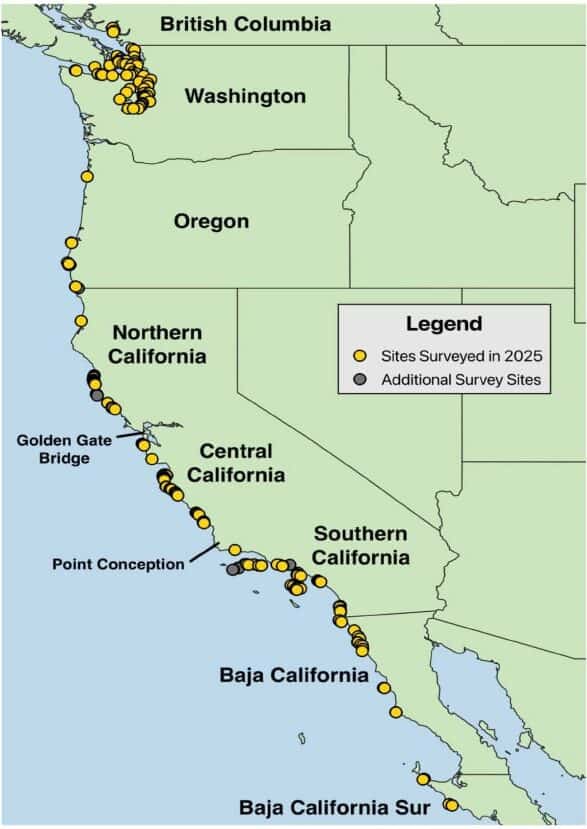
Reef Check is excited to announce the release of our 2025 Kelp Forest Monitoring Report, Status and Trends of the West Coast’s Kelp Forests, marking a significant milestone: 20 years of scientific monitoring, community engagement, and ocean stewardship. Since launching our Kelp Forest Monitoring Program in California in 2006, Reef Check has expanded its kelp monitoring efforts to Oregon, Washington, British Columbia, Canada, and Baja California, Mexico. Today, the program represents one of the largest long-term underwater kelp forest monitoring programs on the West Coast, providing invaluable information about how these ecosystems are changing over time.
The numbers tell an extraordinary story:
- 20 years of continuous kelp forest monitoring
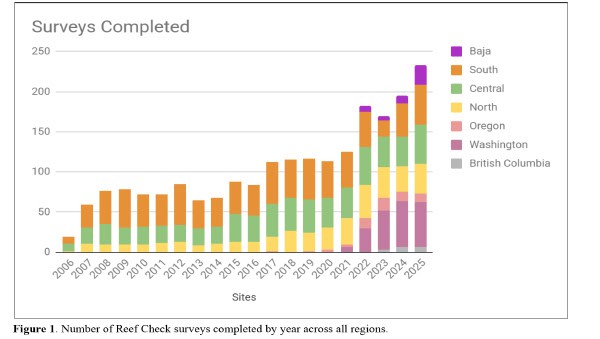
- 233 monitoring sites established across the West Coast
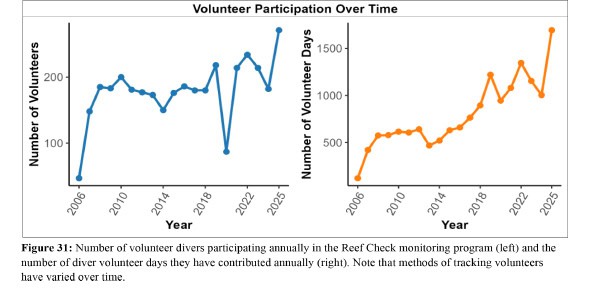
- 271 trained volunteer divers participating in 2025—a new program record
- 1,693 volunteer days contributed during the 2025 monitoring season
- 2,127 scientific surveys completed since 2006
Behind every survey is a dedicated community of volunteer divers, scientists, and partners working together to better understand and protect these remarkable underwater ecosystems.
A Changing Underwater Landscape
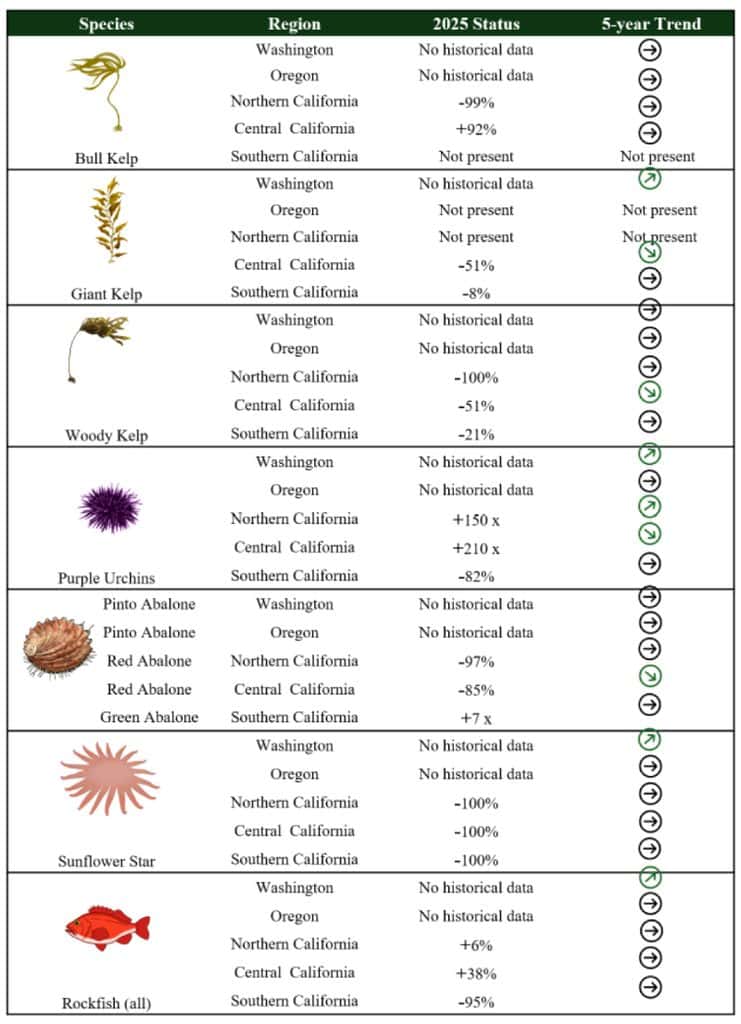
The 2025 report reveals a complex picture of kelp forest health across the West Coast, with signs of both resilience and continued ecological stress. A decade after the devastating marine heatwave of 2014–2016, many kelp forests have yet to recover. Once-thriving underwater forests have been replaced in many areas by urchin barrens, dramatically altering the habitat available to fish and other marine life.
- In Northern California, bull kelp remains scarce, with dense populations of purple sea urchins continuing to dominate much of the seafloor. However, restoration projects at sites such as Portuguese Beach and Caspar Cove offer encouraging evidence that targeted restoration efforts can help kelp forests recover.
- Central California presents a mixed picture. While some areas continue to support productive kelp forests, others are experiencing low kelp abundance and elevated sea urchin populations.
- Farther south, Southern California’s giant kelp forests have generally remained more stable, although localized declines have been observed at Catalina Island, Palos Verdes, and San Diego and the invasive algae Sargassum horneri continues to dominate some areas.
- Meanwhile, monitoring in Washington has documented relatively stable bull kelp populations in recent years, alongside encouraging increases in several species, including sunflower sea stars and certain rockfish.
These regional differences demonstrate why sustained, standardized monitoring across such a large geographic area is essential. Understanding where ecosystems are thriving, where they are struggling, and how they respond to environmental change helps scientists and resource managers make more informed conservation decisions.
Twenty Years of Data, Powered by Volunteers
Perhaps the most remarkable story behind this report is the community that made it possible. For two decades, thousands of Reef Check volunteer divers have dedicated their time, skills, and passion to collecting rigorous scientific data beneath the surface. From early morning boat departures to challenging shore entries, these citizen scientists have returned to the same monitoring sites year after year, creating an extraordinary record of ecological change. The data they have collected has been used to inform marine resource management, evaluate restoration projects, support scientific research, guide conservation planning, and strengthen community stewardship of coastal ecosystems. As kelp forests face increasing environmental pressures, this long-term perspective is more important than ever. By understanding how ecosystems have changed over decades, we can better identify stressors, evaluate conservation strategies, and recognize signs of recovery.
Looking Ahead
The findings of the 2025 report reinforce an important message: kelp forests are resilient, but their future is far from certain. Continued scientific monitoring, effective restoration, and collaboration among researchers, resource managers, Tribal partners, conservation organizations, and local communities will be critical to protecting these ecosystems for future generations. As Reef Check celebrates its 30th anniversary in 2026, we are especially proud to reflect on the extraordinary impact of our Kelp Forest Monitoring Program and the dedicated community that has sustained it for 20 years. To every volunteer, donor, partner, and supporter who has contributed to this work: thank you. This milestone belongs to you.
Explore the findings and discover what two decades of monitoring reveal about the future of our kelp forests.
Read the Full 2025 Kelp Forest Monitoring Report