Subscribe to Newsletter
 Donate
 Shop
 0




By Andy Beahrs
Stretching from British Columbia to Baja, Mexico, the 233 sites monitored by the Reef Check Kelp Forest Program often have cultural significance as well as ecological value. In this new series, the Transect Line will dive deep into the human and natural histories of some of the most notable sites.
Today’s piece explores the history of the Chinese fishing village at Pacific Grove’s Hopkins Reef (one of 14 Reef Check sites on the Monterey Peninsula in Central California). It’s the first of two about a shoreline that has drawn fishers and scientific collectors for centuries.
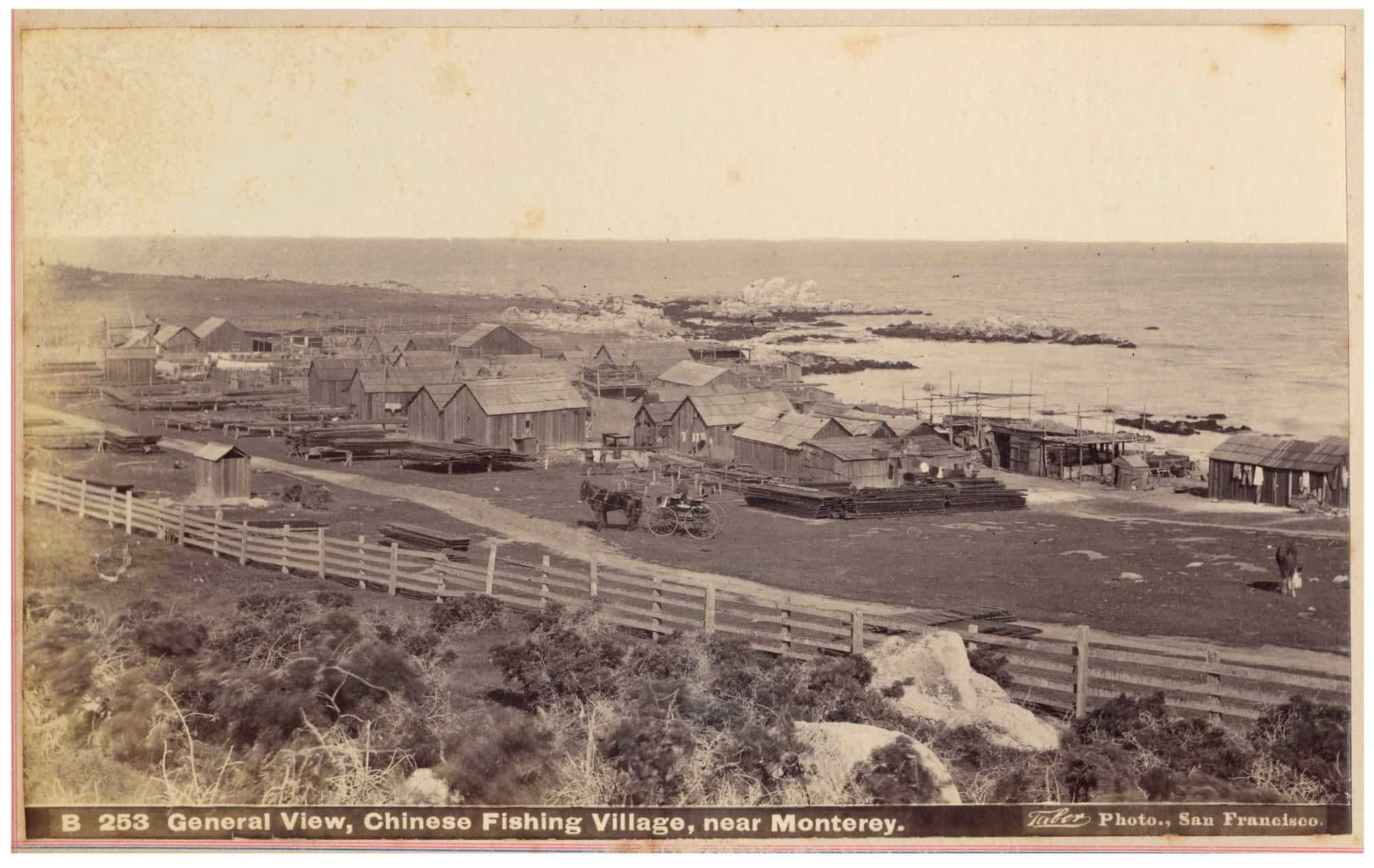
By the time John Steinbeck’s Cannery Row appeared in 1945, the Nobel Prize winning author could describe Point Almejas in Pacific Grove as the private “park-like property of the Hopkins Marine Station,” where a security guard might try to roust out a pair of happy couples enjoying “a miniature beach between little reefs” and the “fine smell of seaweed… from the exposed rocks.” Long before Stanford built the research station, however, the rich underwater environment drew humans to the nearby shoreline. Most famously, the adjacent beach was home to the largest Chinese fishing village on the Central Coast–a village that stood out not only for its size, but for its commitment to building a long-term, family-oriented community that would eventually outlast its redwood slat structures.
In a 1957 Monterey Herald op-ed, Steinbeck recalled “the district known as Chinatown” as having been a “romantic” neighborhood consisting of “shacks built of scraps of wood, matting, [and] pieces of tin” before its 1906 destruction by fire. The seemingly-improvised nature of the village contrasted with the long roots of Chinese fishers on the coast, which may have begun even before the Gold Rush; oral histories tell of small East Asian fishing boats carried out on the great Pacific Gyre current system (in Chinese Wei-Lu, or Ultimate Drain; in Japanese Kuroshiro, or Black Tide) never to be seen again.
Whether or not these craft ever washed up on California’s shores, it’s certain that the gyre that made it impossible for them to return home contributed to the upwelling that eventually made Monterey Bay a prime destination for immigrants from China, Japan, Italy, and Sicily, as well as the United States East Coast. According to Stanford’s Seaside: History of Marine Science in South Monterey Bay, Chinese fishers pursued “abalone, cod, flounder, halibut, mackerel, rock fish, red and blue fish, yellow tail, sardines, and squid” for commercial sale, while also gathering “other delicacies” including sea slugs, sea urchins, seaweed, and various shellfish from the shore (an 1867 Monterey Gazette also mentioned what it called “red and blue fish”).
All were important to the fishers–but it was abalone that first brought them to Monterey. The giant marine snails were so prominent that two rocky points in Pacific Grove are named for the giant marine snails: Point Alones (opposite Point Almejas) and Point Aulon (today Lovers Point, and once home to an earlier iteration of the Hopkins marine station). According to Sandy Lydon’s Chinese Gold: The Chinese in the Monterey Bay Region, the “abalone rush” began in April 1853 with the arrival of a small camp of a half dozen Chinese in Monterey, who–unlike the local whites–were delighted to find that the hunting out of local sea otters had allowed Haliotis to explode in both size and number. As word spread to Chinese in San Francisco, the fishery spread to Point Lobos and, by 1856, Point Sur.
The specific origins of the Chinese at Point Almejas will probably never be known. Lydon believes that some may have been Tanka “Boat People,” an ethnic group known for spending their entire lives on board small boats in Guangdong, Hong Kong, and other coastal Chinese regions. What is certain is that they intended to stay; unlike other, nearly all-male villages made up of disappointed gold hunters, the settlement at Almejas included women and children in a community of skilled fishers. Family groups formed “companies” that fished from locally built, twenty-one foot fishing sampans that could be propelled by a sail or sculled with a single oar. Small enough to be hauled onto land before big storms, the sampans were ideal for relatively exposed areas like the beach between Points Almejas and Alones (Monterey’s sheltering Breakwater would not be built until the 1930s).
But the stable, sophisticated fishing families soon came under pressure from newcomers from other immigrant communities, some of whom enjoyed legal protections denied the Chinese. By the late 19th century, Sicilian and Italian fishers were pushing the earlier residents around the peninsula towards Carmel; any attempt at legal pushback was impossible under the Chinese Exclusion Act of 1882, which declared Chinese testimony invalid in court. The villagers gained an economic reprieve in the form of squid, which (like abalone before it) was largely scorned by white consumers. For the fishers of Point Almejas, the squid was valuable not only as a dried foodstuff, but also as a means of smuggling; packing the poor quality squid in copious amounts of salt allowed them to bypass the 2,000-year old imperial salt monopoly and its prohibitive import taxes. The nighttime squid fishery was picturesque enough to become a tourist attraction in its own right, which gained the fishers some support from white residents who otherwise resented the intense odor of the squid drying racks.
The true end, though, came in 1906, with a blaze that destroyed nearly the entire village. Many suspected that the fire had been arson, a final attempt by locals to drive the Chinese out of Monterey. A remnant of the village relocated to McAbee Beach for several years, making a living off of squid–until Monterey passed a permanent ban on drying racks in town. Though other communities would arise in the years and decades to come, the original Chinese village between Point Almejas and Point Alones, which made its living off of Hopkins and other nearby reefs, was gone for good.
The next Site Spotlight will explore Hopkins’s long history of marine science and research.
Sources and Further Reading:
Lydon, Sandy. Chinese Gold: The Chinese in the Monterey Bay Region. Capitola Book Company, Capitola CA, 1985.
Steinbeck, John. Cannery Row. The Viking Press, 1945.
“A Californian Marine Biological Station.” Natural Science: A Monthly Review of Scientific Progress. Volume 11; July-December 189y
“Point Alones Fishing Village.” Seaside: History of Marine Science in South Monterey Bay. Stanford University, 2021.
“John Steinbeck States His Views on Cannery Row.” Monterey Peninsula Herald, March 8, 1857.