Subscribe to Newsletter
 Donate
 Shop
Shop 0
0







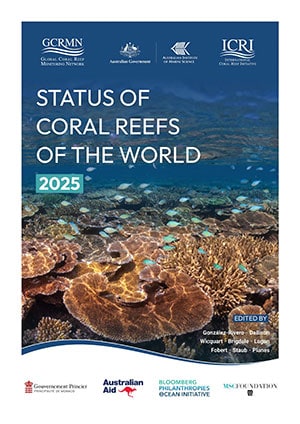
The Global Coral Reef Monitoring Network (GCRMN) has released its most comprehensive assessment of the world’s coral reefs to date. Status of Coral Reefs of the World: 2025 brings together 21.1 million observations from 87,299 surveys at 36,886 reef sites, contributed by 600 partners across more than 120 countries, territories, and economies. The result is the largest global coral reef assessment ever produced—and Reef Check data are part of that picture.
The report’s findings underscore the growing pressure on coral reefs. Global hard coral cover averaged 30.2% during the 1980–2009 reference period, compared with 27.3% from 2020–2024—a relative decline of 9.5%. In 2024, global hard coral cover stood at 25.8%. Between 2023 and 2024 alone, coral cover fell by a relative 8.9%, the largest single-year decline on record.
Climate-driven marine heatwaves are the primary driver of the global decline. Since 1998, four global coral bleaching events have each been associated with relative losses of 6.5–9.9% in global hard coral cover. Since 2010, these large-scale disturbances have been occurring every four to six years in many regions, leaving reefs with less time to recover before the next event.
Yet the report also makes clear that the story is not the same everywhere—and that recovery is still possible. Following the third global bleaching event, global hard coral cover increased by approximately 6% between 2017 and 2019. Across the 10 GCRMN regions, four show long-term declines in hard coral cover, four show no evidence of net long-term change, and two have increased relative to their reference periods. These regional differences highlight the importance of reducing local pressures such as pollution, coastal development, overfishing and unsustainable resource use while addressing climate change globally.
Reef Check Data Help Build the Global Picture
Reef Check-collected monitoring data contributed to all 10 regional chapters of the report: Australia, Brazil, the Caribbean, East Asian Seas, the Eastern Tropical Pacific, the Pacific, the Red Sea and Gulf of Aden, the ROPME Sea Area, South Asia, and the Western Indian Ocean. Several Reef Check coordinators also served as co-authors of their respective regional chapters. The report specifically acknowledges the Reef Check Foundation and the countless hours contributed by Reef Check volunteers to collecting these data.
That contribution speaks directly to one of the report’s central messages: sustained, long-term monitoring is essential to effective coral reef conservation. Consistent monitoring allows scientists and managers to establish baselines, identify long-term trends, connect changes in reef condition with their causes, measure recovery, and determine whether conservation strategies are working. Without those data, it is far more difficult to know where reefs are improving, where they are declining, and where limited conservation resources can have the greatest impact.
For nearly 30 years, Reef Check scientists, coordinators, partners and volunteer citizen scientists have helped build this kind of long-term record. The new GCRMN report demonstrates why that work matters: individual surveys, repeated year after year and shared across borders, become part of the evidence base used to understand the health of an entire global ecosystem.
The situation for coral reefs is urgent, but their fate is not predetermined. As the report concludes, limiting global warming is fundamental to their future, while reducing local stressors, strengthening reef protection, adapting management and investing in monitoring can improve resilience and recovery. Actions taken now can improve outcomes for coral reefs—and for the communities, economies and biodiversity that depend on them.