Subscribe to Newsletter
 Donate
 Shop
 0




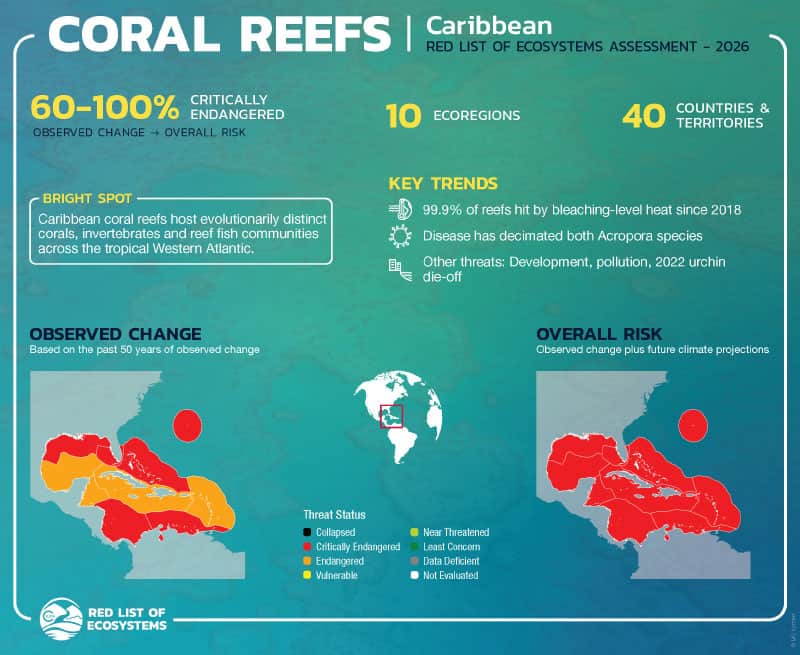
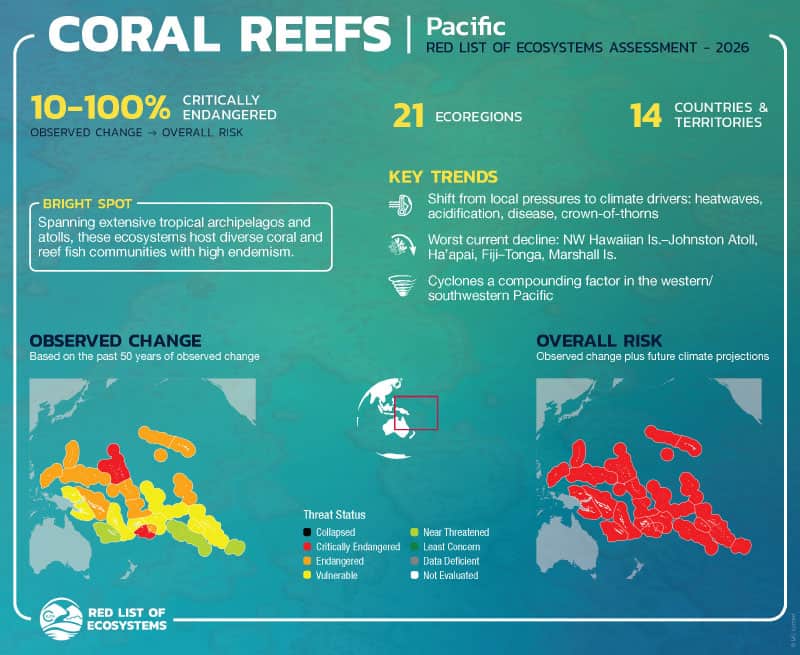
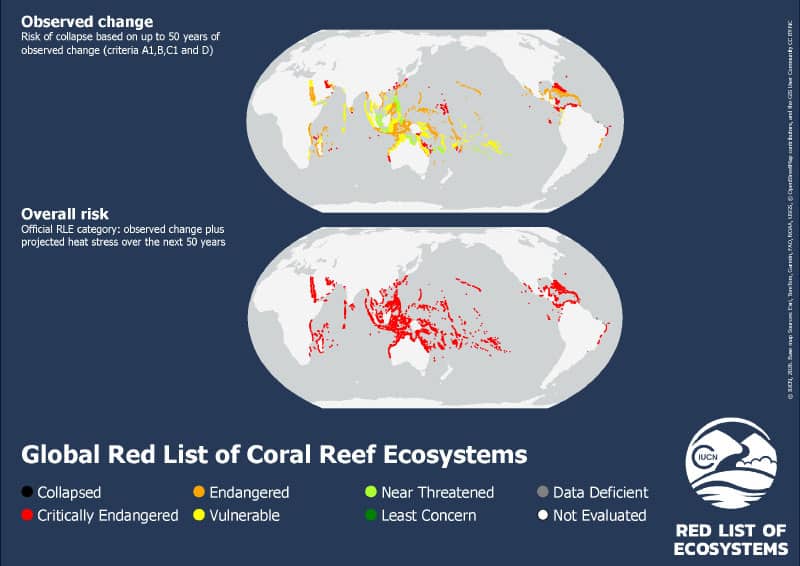
According to a landmark global assessment released by the International Union for Conservation of Nature (IUCN) on October 22, 2026, nearly every shallow-water coral reef ecosystem observed faces an extremely high risk of collapse by 2075. The report classifies 122 of 127 coral reef ecoregions (96%) as Critically Endangered, representing 99.8% of the assessed reef area.
Covering 188,362 square kilometers of shallow, sunlit, warm-water reefs across more than 80 countries and territories, the study is the first global assessment of coral reefs under the IUCN Red List of Ecosystems. Built on the same rigorous, standardized approach as the well-known IUCN Red List of Threatened Species, it evaluates ecosystem health and the risk of collapse using historical observations, current conditions, and future climate projections.
“Collapse” is the ecosystem counterpart of extinction, with one important difference: while extinction is final, collapsed ecosystems may in some cases recover. “Critically Endangered” is the highest category of risk for an ecosystem that has not yet collapsed. It means an extremely high risk of collapse within the assessment period (in this analysis, by 2075), not that collapse has happened.
Reef Check Contributes Across All Regions
Coordinated by IUCN, the University of Melbourne, and CORDIO East Africa, in partnership with regional nodes of the Global Coral Reef Monitoring Network (GCRMN), the assessment brought together more than 250 experts working across 10 regional teams. Reef Check contributed to the assessment across all regions of the report, helping bring expertise and coral reef monitoring data to this comprehensive global evaluation. The contribution underscored the importance of long-term monitoring and collaboration in understanding changes in reef ecosystems and informing conservation priorities.
Climate Change Drives the Greatest Risk
Drawing on decades of reef monitoring data on corals, algae, and fish, satellite records of sea-surface temperature, reef maps, and climate projections, the findings identify heat stress caused by climate change as the most consistent driver of coral reef decline worldwide. Rising ocean temperatures and increasingly frequent marine heatwaves cause mass bleaching events, which can lead to widespread coral mortality.
Using the IPCC “middle-of-the-road” climate scenario projecting approximately 2.7°C of atmospheric warming above pre-industrial levels by 2100, the assessment found that projected heat stress is the trigger for the Critically Endangered classification in 121 of 122 ecoregions.
The consequences extend far beyond coral loss. Reefs provide food and shelter for approximately a quarter of all marine species and support fisheries, tourism, coastal protection, and the livelihoods of millions of people.
One ecoregion, the Western Galápagos Islands, is already classified as Collapsed following catastrophic coral mortality during the 1982–83 El Niño event. Four additional ecoregions could not be assessed because of insufficient data, highlighting the continuing need for monitoring and research.
Turning Assessment Findings into Action
Based on observed changes over the past 50 years alone, 30 ecoregions (24%) are classified as Critically Endangered. When future heat stress is included this increases to 122, revealing both the scale of the threat and the critical window remaining to influence outcomes.
But although the global outlook is alarming, coral reefs are not yet lost. The assessment calls for urgent reductions in greenhouse gas emissions alongside stronger local and national conservation measures. Local pressures—including overfishing, coastal development, pollution and disease—further weaken reefs by reducing their ability to recover between heatwaves. Better fisheries management, effective marine protected areas, improved water quality, and targeted restoration can strengthen reef resilience.
Some areas, including the Northern Red Sea, have demonstrated greater thermal tolerance than many other regions. Identifying and protecting these resilient reefs will be important for supporting future recovery and persistence.
For Reef Check, the findings reinforce the value of science-based monitoring and international collaboration. By contributing across all regions of this landmark assessment, Reef Check helps strengthen the scientific understanding needed to guide reef conservation worldwide. Continued monitoring will be essential to track changes, evaluate conservation efforts, identify resilient areas, and support evidence-based decisions.
The message is clear: while the risk of coral reef collapse is escalating, the future is not yet decided.