Subscribe to Newsletter
 Donate
 Shop
Shop 0
0







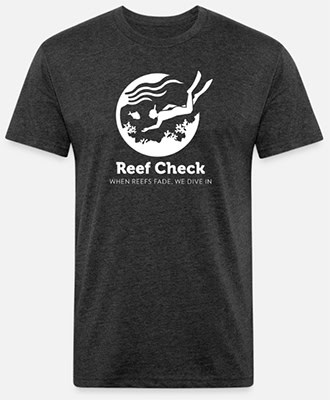
Our limited-edition Coral Bleaching Awareness Month shirt features Reef Check’s bleached logo as a reminder of what reefs stand to lose as ocean temperatures rise.
Wear it to start conversations, raise awareness and show your support for healthy, resilient coral reefs.
Proceeds from every purchase support Reef Check’s worldwide reef monitoring and conservation work.
Coral bleaching is changing reefs around the world, so this September, we’re giving up our color to bring attention to what reefs are facing.
In recognition of the fourth annual Coral Bleaching Awareness Month, Reef Check has joined the Coral Reef Alliance, the International Coral Reef Initiative (ICRI) and hundreds of partners around the world in “bleaching” our logo on social media.
For Reef Check, the campaign is closely connected to the work we have been doing for three decades: getting people into the water to observe, measure and document changes occurring on reefs.
Reef Check was founded in 1996 to address a critical gap in our understanding of coral reef health. The following year, trained volunteer divers and scientists carried out the first-ever global survey of coral reefs using a standardized monitoring protocol. Today, Reef Check’s Tropical Program includes citizen scientist teams in more than 40 countries, conducting more than 600 surveys each year. Since 1997, Reef Check EcoDivers have completed more than 17,000 coral reef health surveys worldwide.
That long-term perspective is particularly important now.
On August 22, 2026, the daily global average sea surface temperature reached 21.10°C (69.98°F), the highest recorded since the Copernicus Climate Change Service dataset began in 1979. At the same time, El Niño is strengthening, with NOAA forecasting a greater than 90% chance that it will become a very strong event during the Northern Hemisphere fall and winter.
For coral reefs already facing increasing heat stress, these conditions are cause for concern—and make consistent monitoring more important than ever.
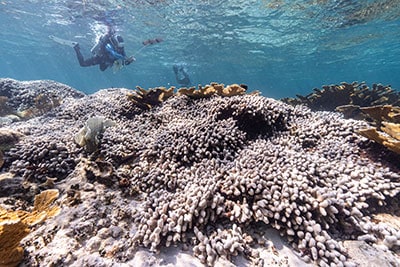
When corals experience prolonged heat stress, they can expel the symbiotic algae living within their tissues that provide much of their color and energy. Without them, corals become pale or white, a phenomenon known as coral bleaching.
Bleaching does not necessarily mean a coral has died. If stressful conditions subside, corals can recover. But severe or prolonged bleaching leaves corals more vulnerable to disease and mortality, while other pressures—including poor water quality and overfishing—can further reduce a reef’s ability to withstand and recover from heat stress.
This is where long-term monitoring makes a difference.
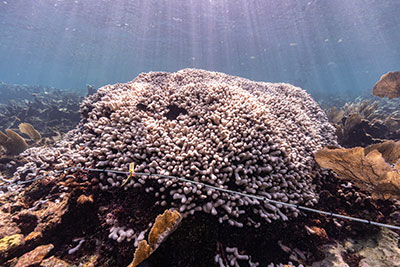
Reef Check EcoDivers use a globally standardized scientific protocol to document coral cover, fish and invertebrate populations, and other indicators of reef health. By returning to reefs and collecting comparable data over time, our teams help create a record of how these ecosystems are changing.
During periods of extreme ocean heat, those observations allow us to put what divers are seeing today into a much larger context—comparing reef conditions before, during and after bleaching events and helping identify not only where reefs are declining, but also where they may be demonstrating resilience and recovery.
Three decades of monitoring have shown us that the story of coral reefs is not only one of loss. Reef Check data also document reefs that recover and communities taking action to protect the ecosystems they depend upon. That is why continuing to monitor reefs through this period of unprecedented change matters.
Bleaching our logo for the month of September is a small symbol of what reefs around the world are experiencing. Keeping trained divers in the water, collecting the data needed to understand those changes, is the work that comes next.
You can be part of it. Your support helps Reef Check train and mobilize EcoDivers, maintain long-term monitoring sites and collect the data needed to understand how reefs respond to extreme heat and bleaching. Please consider making a donation to help keep our teams in the water and ensure that changes happening on reefs around the world do not go undocumented.