Subscribe to Newsletter
 Donate
 Shop
Shop 0
0







Coral reefs cover less than one percent of the ocean floor, yet support roughly a quarter of all marine species. By the early 1990s, scientists suspected these ecosystems were in serious trouble — but had no way to prove it at a global scale. The data simply didn’t exist. Reef Check was born from that gap. In 1993, Professor Robert Ginsburg of the University of Miami convened an international workshop on the Global Health of Coral Reefs, bringing together approximately 250 leading coral reef researchers. The participants sought to answer a fundamental question: What is the health of the world’s coral reefs? They quickly realized that existing scientific studies were too limited in geographic scope and duration to provide a meaningful global assessment. Traditional scientific approaches were not adequately tracking widespread changes in reef ecosystems, making it clear that a new strategy was needed.
Two major initiatives emerged from the workshop. The first was the declaration of the International Year of the Reef (IYOR) to raise awareness of coral reef conservation. The second was the creation of a global reef monitoring program capable of collecting data across vast geographic areas. To design the protocol, organizers turned to coral reef ecologist Dr. Gregor Hodgson — someone who understood both the science and the practical realities of working in the field. His challenge was significant: create a methodology rigorous enough to satisfy scientists, yet simple enough that a recreational diver with no research background could execute it reliably on reefs anywhere in the world.
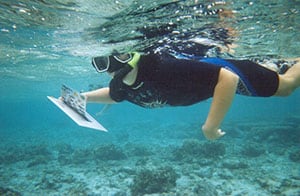
The resulting program, named Reef Check, was designed as a rapid, global assessment of coral reef health using trained volunteer recreational divers working alongside marine scientists. Because external funding was unavailable, the program relied heavily on volunteer labor. Scientists would train experienced divers in reef ecology, species identification, and monitoring techniques, enabling them to collect standardized data using a common survey methodology. The protocol focused on easily identified indicator species and signs of human impact, making it accessible to non-scientists while maintaining scientific rigor.
In 1996, draft protocols were circulated through NOAA’s coral reef listserv and opened to peer review. While many scientists contributed valuable suggestions, some doubted that a monitoring program based on volunteer divers could succeed. After revisions, detailed instructions were published online, and a network of national, regional, and local coordinators was established to organize surveys around the world.
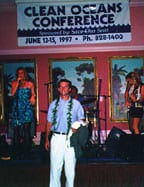
The first Reef Check surveys were conducted during the International Year of the Reef in 1997. An environmental group called Save Our Seas, led by Carl Stepath, organized one of the earliest Reef Check events in Kaua’i, Hawai’i, involving more than 200 participants from universities, government agencies, environmental organizations, and the private sector. A 2.5-month survey window was established so that teams worldwide could collect data within a comparable timeframe.
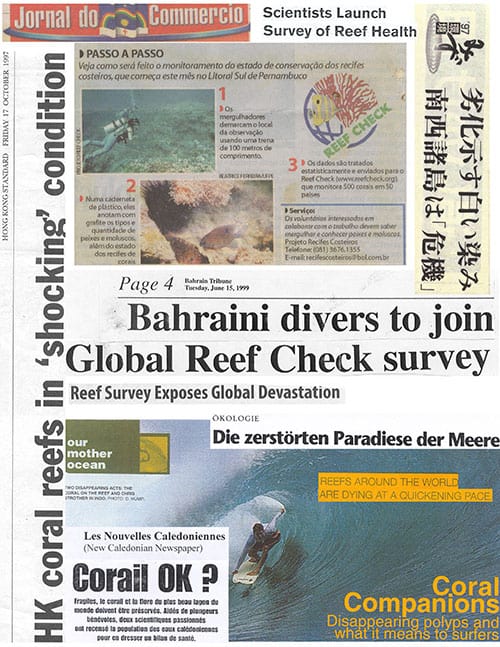
The results exceeded expectations. By the end of the initial survey period, more than 300 reefs in 31 countries and territories had been assessed, making it one of the largest ecological surveys ever conducted. The findings, presented at a press conference in Hong Kong later that year, demonstrated that human impacts were affecting coral reefs worldwide, including many remote and previously considered pristine locations. By the end of 1998, Reef Check had expanded to more than 400 surveyed reefs across 40 countries and territories, involving hundreds of recreational divers, scientists, and community members.
The program’s success led to a formal partnership with the Global Coral Reef Monitoring Network (GCRMN), which adopted Reef Check methods for community-based monitoring. What began as a one-time global assessment quickly evolved into an annual monitoring effort and, ultimately, into a broader marine conservation organization. Today, Reef Check is recognized not only as a monitoring protocol but also as a global leader in marine education, research, conservation, and community engagement.
Three decades of continuous data is rare in ecology, and what Reef Check’s records reveal is sobering: widespread coral loss, declining fish populations, and the accelerating fingerprints of climate change across reefs that were once considered pristine. But the data also capture moments of recovery — reefs that have rebounded where communities took action. In 2026, that 30-year archive is more valuable than ever, offering scientists a baseline against which to measure both the damage and the hope.
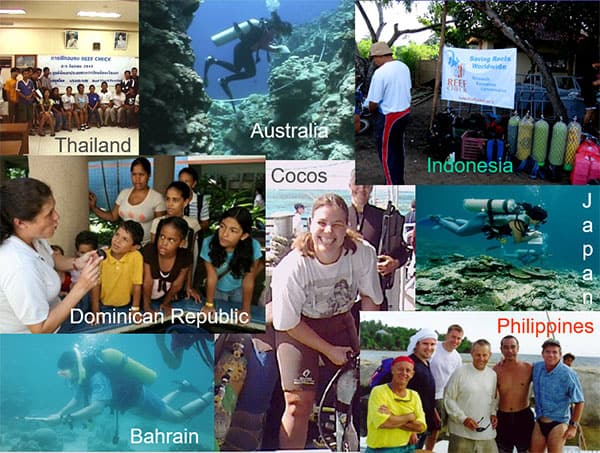
Today, Reef Check operates across dozens of countries, training new cohorts of citizen scientists every year. The reefs they monitor face pressures that would have been hard to imagine in 1997 — intensifying bleaching events, ocean acidification, and mounting coastal development. But as the pressures increase so does the network watching over them. Thirty years in, the question that started it all remains urgent. Reef Check’s answer remains the same: get in the water, look closely, and share what you find.
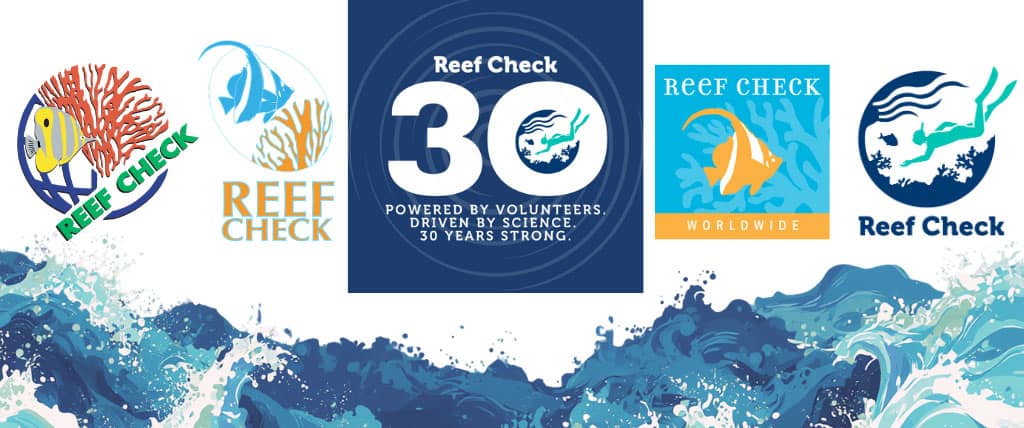
As part of the celebration, we are launching our Reef Check 30th anniversary logo. At its center, a diver represents our volunteers around the world, underwater, paying attention. Radiating outward from that center are concentric rings — like ripples on water — a reminder that a single dive, a single volunteer, a single organization choosing to show up can send waves far beyond what the eye can see.
Celebrate with us by showing your support with brand-new merch featuring the anniversary logo!